Pointe-Saint-Charles History
(La Pointe-Saint-Charles proche la Grande-Anse)
Beneath the Foundations: Indigenous Presence and Early Traces
Long before the alignments of red brick and sloping roofs, the Pointe was a territory of passage, fishing, and encampment for Indigenous peoples. No houses yet stood there, but memory was already taking root in the soil, in rhythm with the river, the tides, and the seasons.
With colonization, the first agricultural structures gradually appeared. In the eastern part of the territory, Saint-Gabriel Farm, on Sulpician land, marked the beginning of an organized relationship with the land: fences, paths, barns. Marguerite Bourgeoys acquired it in 1668, following a land concession in Pointe Saint-Charles. This farmhouse would later help ensure the self-sufficiency of the Congrégation de Notre-Dame. Other religious communities, particularly women’s communities, would later give this territory a more lasting structure, both spiritual and built.
It was not yet a neighbourhood, but already a shaped space. The land was cultivated, and future axes could be glimpsed. Architecture had not yet risen, but it was already there, in seed form: in the way the land was divided, planted, and built upon. A kind of invisible foundation, onto which the working-class memory of the following century would later be grafted.
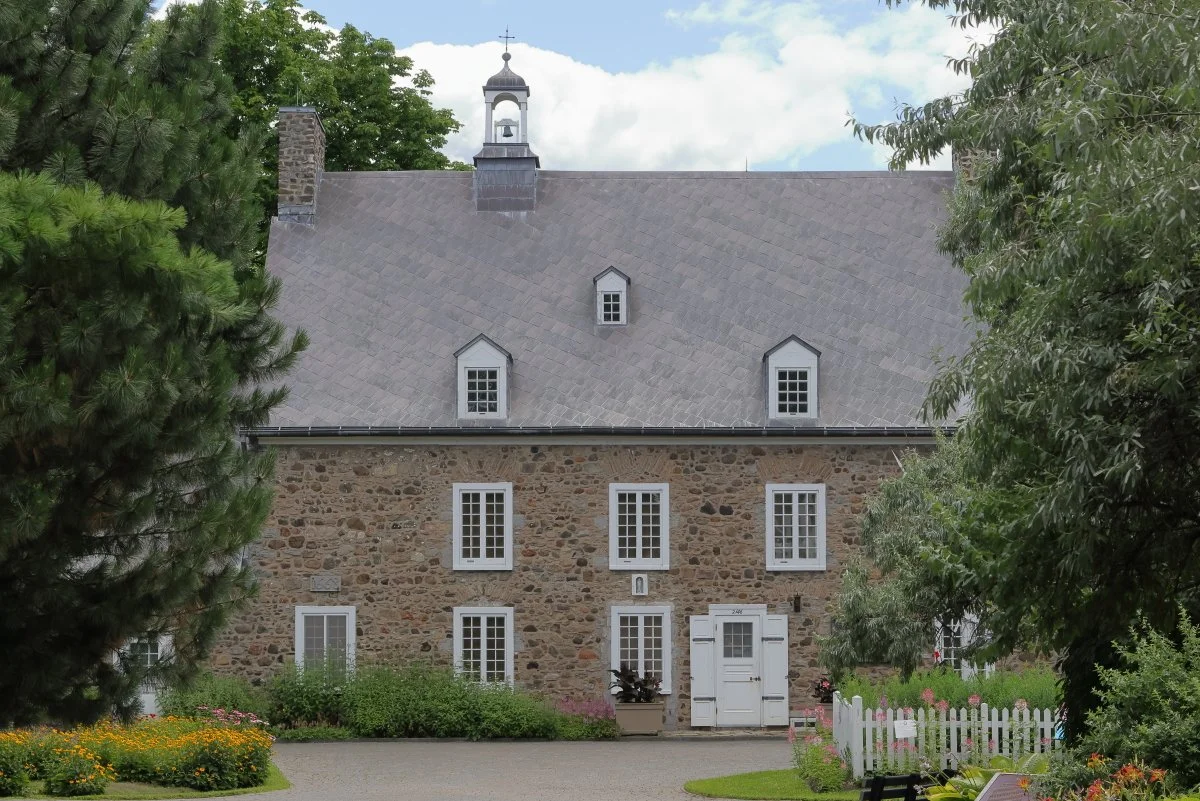
Here, between stone and memory, colonial history takes root on a territory long travelled by the First Peoples. Acquired in 1668 by Marguerite Bourgeoys, Saint-Gabriel Farm bears witness to the first gestures of agricultural structuring in the Pointe.
The Canal, the Brick, and the Families (1840–1875)
The opening of the Lachine Canal in the early 19th century radically transformed the destiny of “La Pointe”, as Pointe-Saint-Charles is locally known. Marshy riverbanks gave way to a vibrant industrial hub: shipyards, warehouses, factories — the neighbourhood began to organize itself around labour.
In 1856, the vast Grand Trunk workshops were established only steps away from the construction site of the future Victoria Bridge, the first railway link to cross the river. This complex for the manufacturing and repair of railcars became the largest industrial enterprise in Montreal. Pointe-Saint-Charles then entered the age of rail, at the heart of a network connecting the Great Lakes to the Atlantic.
Urbanization accelerated, the population soared, and with it emerged a dense grid of streets, houses, and lanes. The first working-class dwellings appeared: narrow row houses, aligned with the sidewalk, often built with local brick. They were modest, but ingenious — two storeys, sometimes three, with stacked galleries, straight or turning staircases, and rear access.
The lots were narrow, the façades repetitive, but every detail revealed a subtle variation, a singularity.
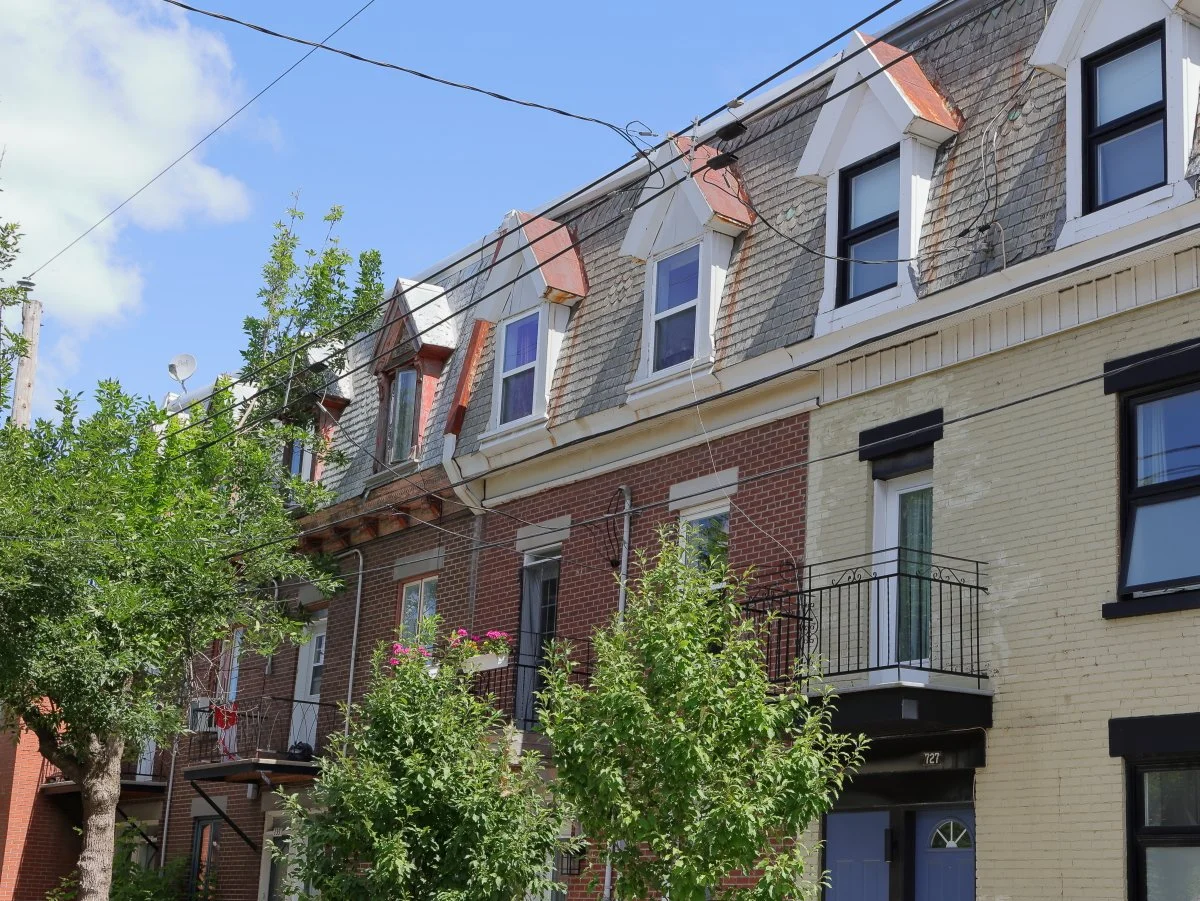
Typical working-class houses in Pointe-Saint-Charles, built in rows with mansard roofs, dormers, and wrought-iron balconies. These brick dwellings bear witness to the neighbourhood’s rapid development toward the end of the 19th century.
Hibernia Street, corner of Rozel Street, east side.
Large families, often Irish, lived there — several generations under one roof, in compact but lively spaces. The working-class neighbourhood was then home to three major cultural communities in almost equal proportions: Francophone Catholics, English-speaking Irish Catholics, and Protestants of British origin — Scottish, English, or Irish.
This diverse neighbourhood gave rise to a rich community life, where churches, schools, and traditions intersected in a closeness that was sometimes tense, but deeply formative.
The neighbourhood took shape in clay, limestone, and dust, fashioned by the hands that inhabited it.
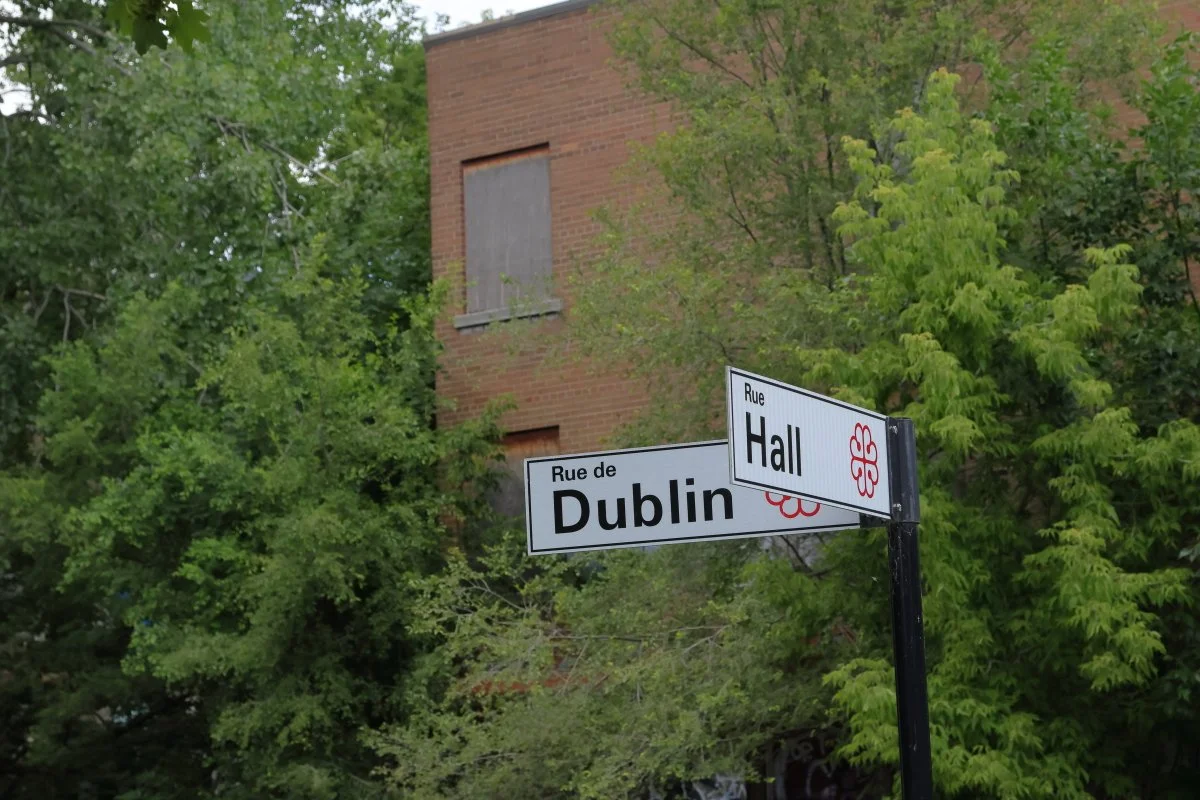
Dublin, Hall, Coleraine, Grand Trunk: the streets of la Pointe still carry the traces of a strong Irish presence. A working-class, spiritual, and familial heritage engraved into the fabric of the neighbourhood.
Institutions, Solidarity, and Roots in Stone
As families settled in, the neighbourhood developed a network of institutions that structured daily life — and marked the landscape. Churches, convents, schools, hospices: architecture was placed in the service of morality, education, and solidarity. Here, stone was not merely a material — it became a principle of order.
Women’s religious congregations, including the Grey Nuns, the Sisters of Saint Joseph, and the Congrégation de Notre-Dame, owned vast parcels of land that they gradually subdivided or built upon. Their institutions — often made of grey stone, imposing in volume but devoid of ostentation — became landmarks within the urban fabric. They bear witness to a moral framework that shaped not only minds, but also the forms of housing.
Around these institutions stood semi-detached houses, sometimes more elaborate: decorative pediments, sash windows, moulded cornices. Architecture translated the ideal of a communal order. Even the lanes, with their wooden fences and discreet sheds, took part in this geography of proximity and duty. In la Pointe, buildings were not erected merely to provide shelter: they were built to form, protect, and guide.
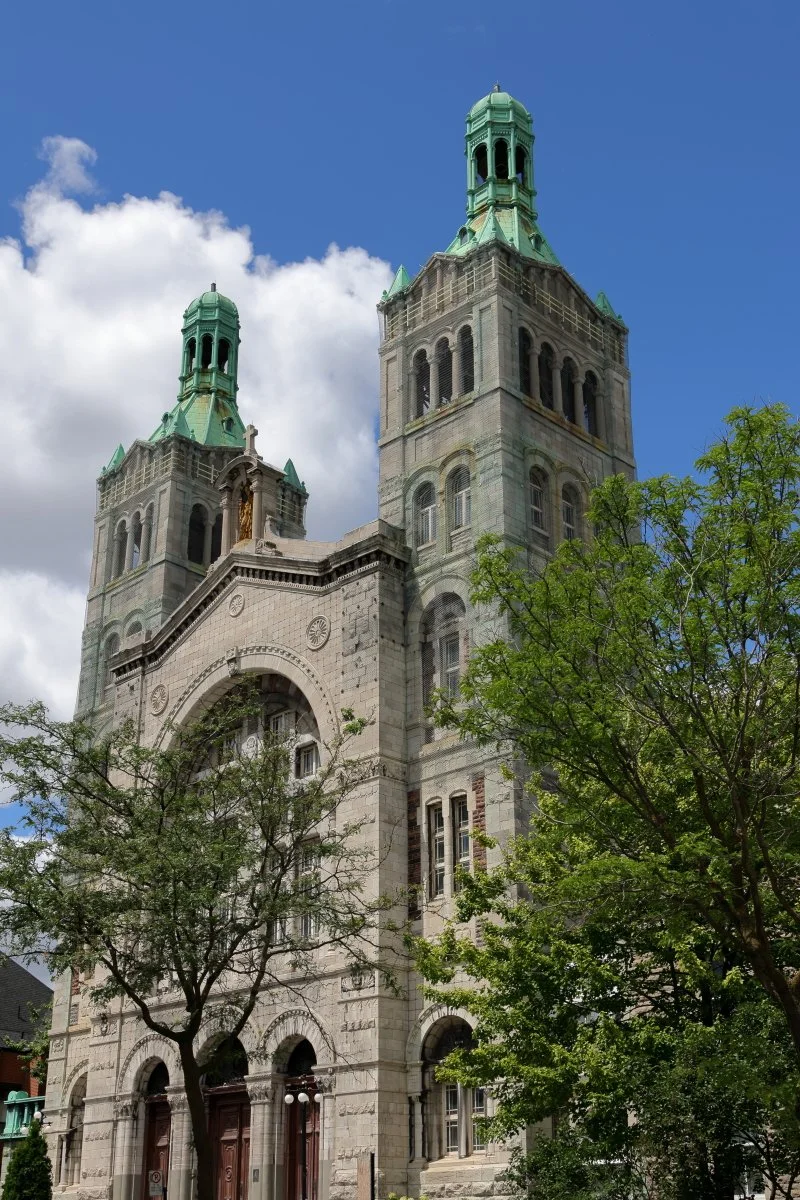
Saint-Charles Church, with its two stone towers and copper steeples, served the Francophone Catholic community of la Pointe. A monument of faith, it embodies the moral and spatial framework that shaped the neighbourhood.
Centre Street, corner of Island Street.
Renovation, Destruction, Survival — 20th Century
The 20th century dealt a harsh blow to Pointe-Saint-Charles. With the decline of heavy industry and the gradual closure of factories, the neighbourhood slowly lost its economic reason for existing in the eyes of planners. What had been built to last was now perceived as obsolete. Working-class houses, once full of life, became the targets of drafting-table urbanism.
In the 1960s and 1970s, entire streets were demolished under the pretext of unsanitary conditions. Affordable housing gave way to standardized real estate projects, often without soul, without roots. Whole sections of the built heritage disappeared, taking with them stories, textures, and forgotten gestures. But memory resisted.
Some houses survived. Sometimes isolated between two newer blocks, they preserved their wooden cornices, wrought-iron staircases, and old windows. They held their ground — like the residents who fought against the systematic demolition of their neighbourhood. Here, resistance is visible in the grain of the brick, in the survival of a dormer, in the persistence of an old alignment. It is no longer only architecture: it is an act of memory.
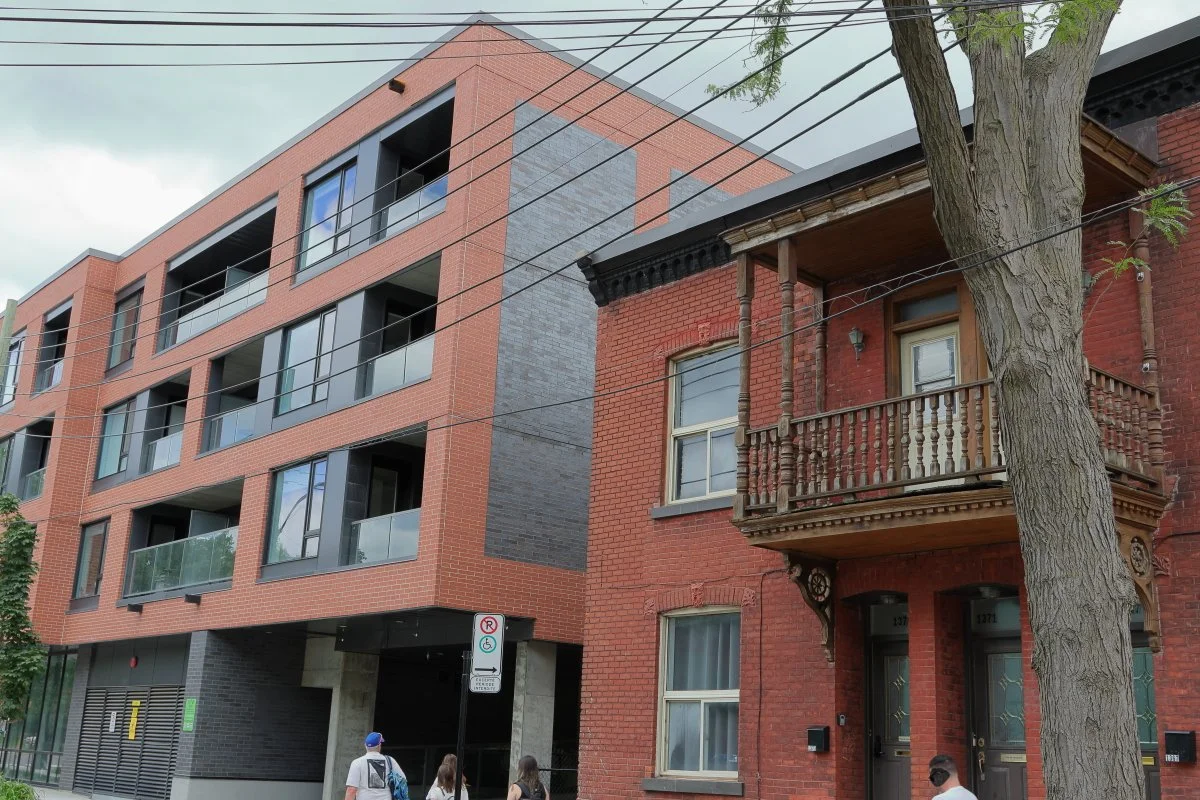
Facing a newly built condominium building, a sculpted wooden balcony recalls the working-class past of la Pointe. Clinging to the old brick, it bears witness to a tenacious memory, still visible in the interstices of the neighbourhood.
Ropery Street, corner of Saint-Patrick Street.
What Remains: A Photographic Gaze on Built Memory
When I walk through Pointe-Saint-Charles, it is not so much history that I seek, but its imprints. A detail of woodwork, a peeling façade, a handrail forged a hundred years ago — all of this speaks to me more than monuments. It is in the modesty of the built environment that I find working-class dignity, the tenacious trace of a collective life now made fragile.
My camera does not capture forms alone; it captures a memory. I try to show how architecture speaks — not through grand gestures, but through repetition, wear, and the discreet variation between two neighbouring houses. Balconies lean, bricks breathe, staircases creak: all of this bears witness to a neighbourhood still inhabited, even as the families have changed.
To photograph Pointe-Saint-Charles is to try to hold on to what may disappear — not out of nostalgia, but out of respect. For in every cornice that endures, there is a fragment of Montreal that cannot be rebuilt. It can only be preserved. And passed on.
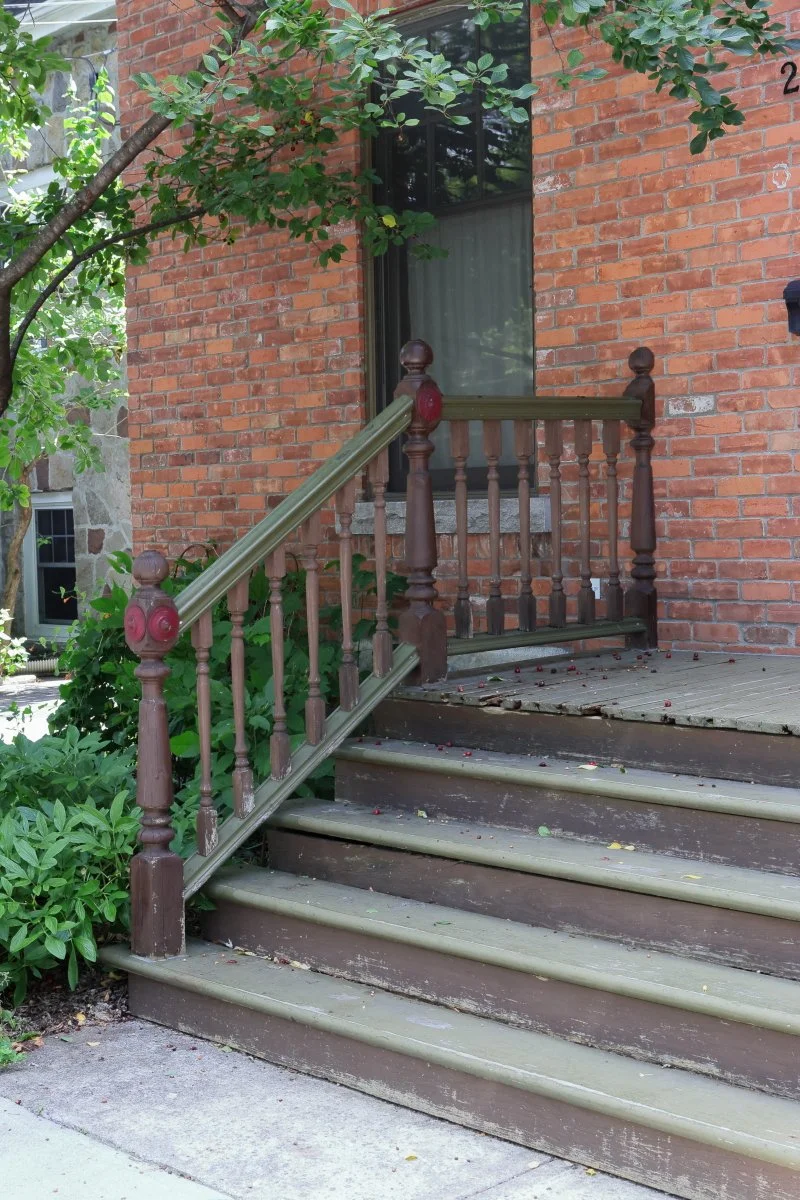
A few steps, a turned railing, wood weathered by the seasons. This unassuming detail, barely noticed, nevertheless carries the silent memory of a working-class neighbourhood.
Rushbrooke Street.