
Saint-Henri History
Saint-Henri Park
Beneath the tall trees and the fountain, the memory of the neighbourhood still flows. Here, the shade is gentle, and history mingles with the daily lives of passersby.
Origins and Toponymy of the Neighborhood
Long before maps, names, and administrative boundaries, the territory now known as Saint-Henri was part of the lands travelled and inhabited by Indigenous peoples, including the Kanien’kehà:ka (Mohawk), the traditional guardians of the region.
Later, with the arrival of French settlers and the establishment of religious domains, the neighbourhood took on a new form, shaped by colonial history. Its full name, Saint-Henri des Tanneries, evokes both a founding activity and a spiritual lineage: in 1810, when the Sulpicians decided to establish a filial chapel in the western outskirts of Notre-Dame, they named it in honour of Henry II, Emperor of the Holy Roman Empire. Saint Henry was also the patron saint of the Sulpician superior of the time, Auguste-Henri Roux. The village that formed around this chapel would carry the same name.
Thus, beneath the apparent neutrality of the name lies a complex fabric in which spiritual, artisanal, and political layers overlap. Even today, echoes of these origins resonate in the neighbourhood’s former names: Coteau-Saint-Pierre, Les Tanneries des Rollands, Saint-Henri des Tanneries — names that speak of the buried memory of a place shaped by hands and stories.
A vibrant mural in Brewster Park reminds us that colour, too, lives on the walls of memory. Here, urban art and heritage meet at human scale.

From Agricultural Lands to Working-Class Villages
Over the centuries, the fertile lands bordering the Lachine Canal were divided and transformed. At first, they were home to farms; then, with Montreal’s growth, they became a mosaic of distinct villages: Côte Saint-Paul, Saint-Augustin — later Verdun — Sainte-Cunégonde, now Little Burgundy, Coteau Saint-Pierre, and others. Each had a clearly defined identity, though their boundaries shifted according to religious, commercial, and political decisions.
In 1874, Saint-Henri was officially incorporated as a municipality, separated from the larger municipality of Hochelaga. Its territory, then extensive, reached as far as the river and included part of what would later become Westmount.
This initial configuration, now largely forgotten, helps explain the architectural richness of the neighbourhood. At the crossroads of rural and industrial zones, Saint-Henri developed a hybrid architecture — neither entirely working-class nor entirely bourgeois — where modest brick houses, Victorian residences, and imposing public buildings stood side by side.
As early as the late 17th century, tanneries were established along the banks of the Saint-Pierre River, initiating an industrial vocation that even predates the opening of the Lachine Canal. This founding past, now almost erased, still permeates the soul of the neighbourhood.

Former Industrial Laundry - Parisian Laundry
Behind its brick arches, generations of workers laboured in the shadow of machines. Now an exhibition space, the building embodies the physical memory of a neighbourhood shaped by manual labour.
On Saint-Antoine Street, near Bel-Air Street.

Former Industrial Building, on Brewster Street
Built in the early 20th century to house manufacturing activities, this building bears witness to the working-class force that shaped Saint-Henri. Now converted into offices, it still carries the visible marks of a defining industrial past.
The Lachine Canal: Engine of a Transformation
The opening of the Lachine Canal in 1825 transformed both the economy and the appearance of Montreal’s southwest district. Saint-Henri became a major industrial crossroads: tanneries, tinsmithing workshops, foundries, and textile mills were established along the canal, attracting a large workforce.
Urbanization accelerated. Narrow streets, transverse lanes, and row houses with wrought-iron or carved wooden balconies still bear witness to this period of intense activity. Buildings were erected quickly, but not without care: even the most modest working-class houses still carry the mark of architectural pride, with their ornate cornices and brightly coloured façades.
The neighbourhood grew and became denser, while retaining the morphological coherence characteristic of this era of rapid industrial development.

Beneath pointed roofs and sculpted cornices, these façades speak of the pride of a working-class past. Each dormer, each moulding seems to whisper the story of a neighbourhood built with care, in the feverish momentum of the industrial age.
On Laporte Street, near the corner of Saint-Jacques Street.
Crises, Decline, and Grassroots Struggles
After the industrial golden age, Saint-Henri underwent profound transformations. The closure of the canal in 1970, the exodus of industries, and expropriation policies left lasting scars. Several working-class blocks were demolished, and families were displaced.
By the late 19th century, Saint-Henri had become an autonomous town, before being annexed to Montreal in 1905 — an administrative shift that accompanied the neighbourhood’s major social transformations.
But the neighbourhood resisted. Sustained by a tradition of solidarity, it became fertile ground for community movements and the defence of social housing. Architecturally, the urban fabric weakened, but did not disappear. Brick houses with crumbling pediments, leaning balconies, mismatched cornices: all signs of a neighbourhood surviving, against all odds, through adverse winds.
It was also during this period of turbulence that a heritage consciousness began to take root, later nourishing preservation efforts.

Damaged walls, boarded-up storefronts, striking graffiti: here, the urban fabric bears the scars of a wounded yet living neighbourhood. Saint-Henri resists, speaks out, and transforms.
Saint-Antoine Street, corner of Laporte Street.

Crumbling façade, altered cornices, mismatched windows: within this weathered architecture is inscribed the memory of a working-class neighbourhood, forged through struggle and solidarity.
Saint-Antoine Street, corner of Brewster Street.
Living Memory and Renewal
Today, Saint-Henri is being reborn, but not without its wounds. Lofts now inhabit former factories, and cafés have settled into old warehouses. Yet behind the renovated walls, the soul of the neighbourhood persists: that of lived-in lanes, and of former villagers who have become witnesses to a world in transition.
For me, photographing this neighbourhood is not merely an aesthetic exercise. It is an act of commitment to working-class memory, to a vernacular architecture that still bears the marks of labour, ingenuity, and resilience.
To photograph Saint-Henri is to question the trace, to translate into light the stories of a place that continues to evolve, between erasure and transmission.
My approach is also part of a broader collective effort of memory, carried by citizens and organizations such as the Société historique de Saint-Henri, who work to preserve the neighbourhood’s stories through archives, exhibitions, and local initiatives.

Le Labo, a Former Industrial Building Converted into Rental Apartments
From factory to laboratory of ideas, this converted building bears witness to the transformations of Saint-Henri. Through its preserved walls, one can still sense stories of labour, creation, and the persistence of a living working-class memory.
On Saint-Antoine Street, near Greene Avenue.
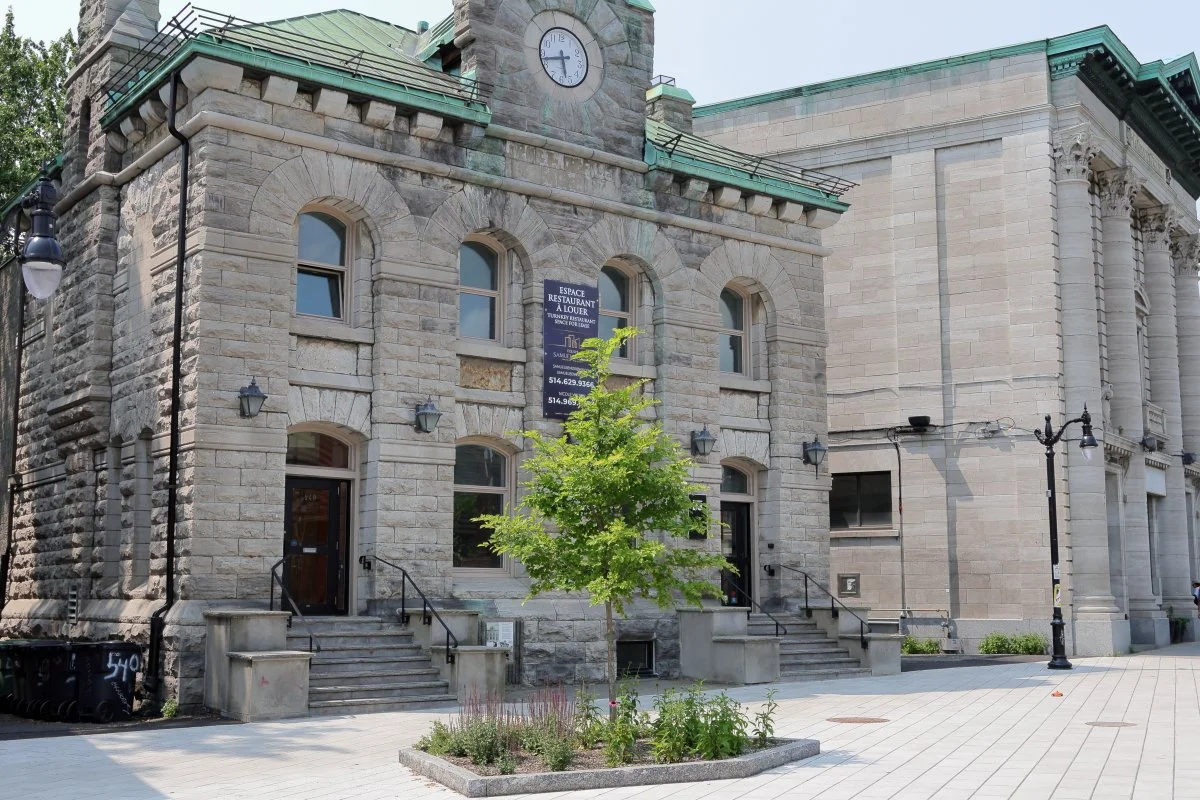
Beneath blond stone and patinated copper, the institutional heart of old Saint-Henri still beats. This place of memory, now awaiting a new life, embodies the soul of a neighbourhood being reborn without denying its past.